
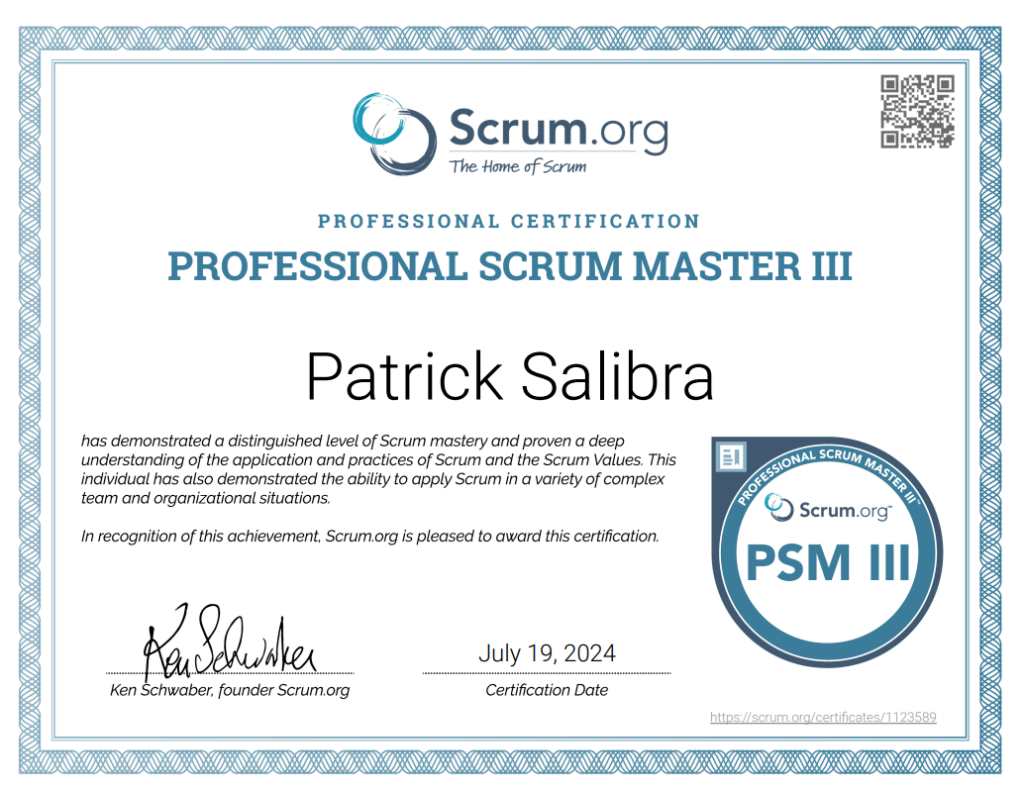
Recently, I achieved the Professional Scrum Master III (PSM III) certification the highest Scrum Master certification offered by Scrum.org. For many people, it’s just another badge or LinkedIn headline. For me, it represents something much deeper.
It’s not just proof of knowledge.
It’s proof of experience, reflection, and maturity in how I think about Scrum.
What PSM III Really Represents
PSM III is not a multiple-choice exam. It’s an assessment that challenges how you think, reason, and respond to complex, real-world situations.
It tests your ability to:
- understand complex team and organizational dynamics
- recognize systemic patterns rather than isolated problems
- choose interventions based on context, not dogma
- lead without authority and influence without control
There are no “perfect” answers only thoughtful, context-aware ones. That’s what makes it so demanding, and so valuable.
My Personal Learning Journey
When I first started as a Scrum Master, my focus was largely on:
- facilitating events
- making sure Scrum was followed “by the book”
- protecting ceremonies and roles
Over time and through working with many different teams that perspective changed.
I learned that:
- frameworks are not the goal
- context always matters
- teams grow when they are trusted, not controlled
- real leadership is about enabling learning, not enforcing compliance
By the time I pursued PSM III, it no longer felt like a stretch goal. It felt like a reflection of how my thinking had evolved: less dogma, more humanity; fewer rules, deeper understanding.
Key Lessons I Took Away
1. Scrum is simple — but never easy
The rules are straightforward. Applying them in complex environments is not.
2. Leadership is influence, not authority
A Scrum Master with no formal power can still create meaningful change.
3. Teams grow through autonomy and safety
Focus, trust, and psychological safety are prerequisites for improvement.
4. Pattern recognition beats checklists
Teams don’t change because of task lists — they change when they understand their own behavior.
What This Means (For Me, and for You)
Whether you’re new to Scrum or have years of experience, PSM III invites reflection:
- Are you focused on events or outcomes?
- Do you enforce rules, or create space for learning?
- Are you fixing symptoms, or addressing systemic causes?
PSM III is not a trophy.
It’s a reminder to practice Scrum with intent, humility, and awareness.
Gratitude
This journey wasn’t just about studying. It was about learning through real work:
- colleagues who challenged my thinking
- teams that trusted me in complex situations
- conversations that forced me to reflect
This certification is mine in name, but shaped by many.